|
Previous
Projects
Duration:
June 1999/September 2001
Location: UK (London)
Funders: Bridge House Estates Trust Fund
A
community consultation event with a residents group in Aldgate,
East London. The group are seeking to secure the only remaining
open space in their locality for community use. WDS facilitated
a consultation event in January 2001, that the residents group had
organised to seek the views of the wider community. There was a
range of participative activities that enabled and encouraged people
to express their views and opinions and to explore their aspirations
for the open space.
Back
to top
Duration:
June 1999/September 2001
Location: UK (London)
Funders: Bridge House Estates Trust Fund
Aims
and objectives
This
project aimed to address the diversity of lifestyles of disabled
women and to consider how housing design can maximise their 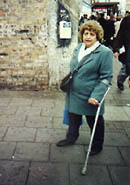 independence and assist them to realise their ambitions. The project
aimed to provide information to the managers, designers and developers
of social housing that will enable them to build more appropriate
accommodation in the future.
independence and assist them to realise their ambitions. The project
aimed to provide information to the managers, designers and developers
of social housing that will enable them to build more appropriate
accommodation in the future.
Method
This
project was be supported and guided by a steering group with representatives
from RADAR (Royal Association for Disability and Rehabilitation),
GLAD (Greater London Action on Disability), Housing Associations,
Access Officers, occupational therapists and disabled women.
The
project involved the following:
- literature
review;
- interviews
with key representatives from disability organisations, activists,
housing associations, allocations officers, architects and access
officers;
- case
studies;
- production
and publication of good policy and practice guidance;
- training
and dissemination of research findings;
Back
to top
Summary
Women's
Design Service initiated this project because it is concerned that
most social housing is not built to be adaptable to individual requirements,
but to conform to stereotypical preconceptions of people and their
needs. Housing for disabled women has seldom been designed in consultation
with the women to be accommodated, and often assumes notions of
disabled women as elderly and single, or a dependent family member.
Although housing is particularly important to disabled women, because
it potentially provides an environment that can be adapted to meet
individual choices and preferences in a manner often impossible
in the public sphere, the constraints of standard room layouts,
fittings and other features can create unnecessary barriers to chosen
lifestyles.
The
Housing for Independence project worked in collaboration with a
range of organisations, groups and individuals involved in disability
issues to define major concerns with existing approaches to housing.
It took a biographical case study approach to examine the lifestyles
of six disabled women, such as a student, a parent, a homeworker.
Issues such as opportunities for socialising, working, cooking,
caring for others, household tasks and relaxing within the home
were explored from their perspectives and housing design principles
and consultation processes were developed to facilitate meeting
different lifestyle requirements and reduce unwanted dependence
on other people. The project continues to disseminate the findings
of this research through the publication of the good practice design
guidance, interactive training and education packages, policy briefings,
consultations and forums.
Enquiries are sought from those interested in purchasing the good
practice guidance or wanting information about training workshops.
Please
contact Wendy Davis at WDS.
e-mail: [email protected]
Back
to top
This was a one year Project based in the West Euston Partnership
regeneration area in the LB Camden. A large estate was undergoing
a major programme of housing security and repairs works. WDS developed
the involvement of residents in this process and was successful
at reaching a wide range of different community groups.
The West Euston Partnership (WEP) is funded by the Single Regeneration
Budget to undertake a five year regeneration programme in the London
Borough of Camden. The West Euston area is geographically small,
but densely populated and ethnically diverse. It lies between Euston
station and Regents Park. WEP's regeneration activities have three
main aims, to 'create economic opportunities', 'unite a diverse
community' and 'share a safer environment'. With these aims in mind,
WEP commissioned Women's Design Service to facilitate Neighbourhood
Health and Safety Audits (NHSA) with local women. The project lasted
three months, from January to March 1999, and worked with three
groups of women from the Somali, Bangladeshi and White British communities.
Three
sites were audited of which two were open spaces and the third a
medical centre. Many of the more practical findings from the audit
locations overlapped and repeated for the different groups. However
some of the findings revealed inconsistencies in the way that the
three cultural groups perceived their environment and access to
facilities and services. This was particularly noticeable in response
to more open questions about issues that affected women's health
and safety. In particular, the Somali women felt isolated within
the community. They were relatively new to the area, had little
contact with each other and restricted access to information and
advice. Following the audit groups, a separate session was held
with the Somali women to consider the wider issues they had raised.
At this meeting the West Euston Somali Women's Group was formed
to give women the opportunity to meet regularly and to make contact
with projects and service providers in the area.
This
is a good example of the richness of the Safety Audit process. As
well as identifying physical problems with the built environment
and producing practical solutions, the women share their considerable
knowledge of their neighbourhood and raise issues which affect the
quality of their lives on a day to day basis. The process reveals
the complexity of the issues faced by women in particular and the
community in general.
Back
to top
Title:
Camden Audits: Neighbourhood Health and Safety Audits with
minority ethnic groups in the London Borough of Camden.
Duration:
April 1996/March 1999
Location: London Borough of Camden
Funders: Camden Joint Consultative Committee (Healthy Cities Programme)
Aim
of project:
The
Neighbourhood Health and Safety Audit: working with minority ethnic
groups in Camden (NHSA) project was developed by Women's Design Service
(WDS) to support women from minority ethnic communities living in
LB Camden to make changes within their local environment that would
have a positive effect on their health and personal safety.
The project provided an opportunity for women
to express their views and ideas for change in the design of their
local environment and delivery of services that would have a positive
effect on their health and personal safety, particularly in terms
of cultural access.
By the end of the project
the audit groups had between them had made more than 50 findings
and recommendations about their local neighbourhoods. This proved
the success of the project as a consultation and research process
and indicated the enormous enthusiasm of audit participants, when
they were given the opportunity to express their views in a meaningful
and in-depth context. The audit groups' findings and recommendations
were converted into an action plan, which formed the framework for
the implementation process undertaken during 1998/1999.
Achievements and outcomes:
This project substantially
met its main aims and in some areas even exceeded its objectives.
The audit process developed by WDS has proved to be most effective
as a method of consultation with small groups about health and safety
issues, particularly with sections of society that often get left
out of public consultation strategies; for example young people,
older people, women, people with disabilities and people from minority
ethnic groups.
The process facilitates community-led
solutions to community safety and sustainable and quality neighbourhoods.
Its usefulness as a consultation strategy has been recognised by
various agencies and urban regeneration partnerships and has already
led to WDS becoming involved in other neighbourhood audit projects
for the West Euston Partnership, Stepney Housing and Development
Agency (SHADA) and Youth Clubs UK.
WDS is planning to extend
and expand its work in the field of community safety in the future
and would be pleased to receive enquiries from any professional
agencyor community groups who would like information or assistance.
Publication references:
A final report detailing
experiences and achievements of the project and suggested succession
strategies Safety, Health and Diversity was published in March 1999.
A resource book, Making
Safer Places, was published in October 1998 and has
been used to disseminate the audit methods nationally.
Back
to top
home
|about us |services
|lwpf | projects
|publications |new
|