.services
.publications
.income
.HOME
.MEMBERS AREA


PROJECTS
Current Projects
Making Safer Places
top
"Urban environments where women feel safe to go
about their everyday lives without fear"is the vision behind the Making Safer Places project. The quotes below illustrate that women want to live, work and socialise in safer environments and that women have something to contribute to the community safety agenda.
" I will definitely notice things like hidden corners and lighting levels now but I also think that I could get in touch with the council and say I think it is dangerous here, what are you going to do about it?"
Project participant from the School's Safety Check: Pedestrian Routes in Hammersmith and Fulham."Safety in the area would increase if there were more amenities or the opening hours for shops were extended, as this would increase the number of people in the street and not make it seem so deserted"
Project Participant from the Bangladeshi Women's Shopping Audit Group.
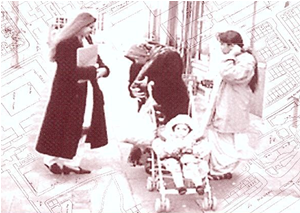
Women engaged in an audit
Making Safer Places is specifically interested in the experience of Black and minority ethnic women, older women and disabled women, whose social and physical vulnerability - both real and perceived - makes an impact on their quality of life. The wider community in urban areas and policy/decision-makers with a regeneration and community safety remit are also key interest groups.The project will bring women onto the regeneration and community safety agenda so that they can enjoy a greater sense of safety, develop their self-confidence, economic and social independence and contribute to a more sustainable community life.
This three-year project started in November 2002 with core funding from Community Fund England. There are two project workers:-
Harriet Wilkins Policy Development Worker [email protected]
Hawah Bunduka Training Development Worker [email protected]
PROJECT PARTNERS
A consortium comprising Women's Design Service (lead organisation), Neighbourhood Initiatives Foundation, (www.nifonline.org.uk) and Crime Concern (www.crimeconcern.org.uk) conceived Making Safer Places.Making Safer Places works in Manchester, Bristol and the London Borough of Islington, and is informed and supported by our project partners:
Manchester City Council www.manchester.gov.uk
Bristol Women's Forum www.bristol-city.gov.uk search for Bristol Women's Forum
EC1 New Deal, Islington www.ec1newdeal.com
The consortium and project partners provide Making Safer Places with strategic leadership through a steering group. Similar structures providing a more local, operational focus are also planned.
Northmoor Road Community Centre, Manchester
AIMS
PROJECT ELEMENTS
OBJECTIVESTraining and supporting women living in communities to engage with community safety issues
A set of criteria has been drawn up to ensure that our target group is well represented, that there are community structures in place that MSP can fit into and that there are resources available to ensure that some recommendations identified by women living in these communities can be implemented.
Following presentations and meetings in Manchester, Islington and Bristol we agreed on the neighbourhoods we would work in.
Promoting a gender perspective on community safety policy and practice
Making Safer Places has started to develop a profile on women and community safety. Harriet Wilkins has been invited to make presentations at the following urban events:
-
Urban Forum ‘The Environment’ Conference November 2002.
-
London Women’s Planning Forum ’24 Hour City’ Conference January 2003. paper from the 24 Hour City presentation
-
Manchester Women's Voices Conference
To work with organisations in the community, voluntary, academic and statutory sectors to engage with women on community safety issues
Meetings have been held with academics with a gender and community safety focus based at London School of Economics, University of East London, University of West England and Sheffield Hallam University with a view to developing our unique position on women and community safety in urban settings.
In addition, a number of site visits were carried out in Manchester, Hammersmith and Fulham (although our focus has now changed to the London Borough of Islington) and Bristol, which incorporated publicising the project, developing our knowledge of the key issues and making contacts with key stakeholders in the areas.
A project outline has also been produced and distributed to a range of local, regional and national contacts, many of whom operate beyond our target cities.
To convene a network on gender and community safety
Making Safer Places is starting to develop a profile in and beyond our target cities, which will form the basis of a network. We have also started to monitor the work around regeneration, community safety and community involvement both nationally (e.g. Neighbourhood Renewal Strategy ODPM Neighbourhood Renewal Unit, Home Office Active Community Unit, Living Streets, Secured By Design) and locally (e.g. Neighbourhood Renewal Strategies Crime Reduction Strategies, Community Strategies, Local Strategic Partnerships).
PROJECT PLANS
Our current priorities are as follows:
establishing local bases
phasing in community safety auditsidentifying and setting up publications database
developing contacts with themedia
continuing to raise the project profiledeveloping contacts databases
These priorities are underpinned by a need to establish a mechanism for monitoring and evaluating the project, which will include establishing baselines amongst audit groups, our target areas and policy makers.
The 24-hour city - implications for women's safety -
a paper presented to the London Women and Planning Forum January 2003.
Click here to read and download details
WDS's Policy Worker on this project is Harriet Wilkins.
Contact: [email protected]Manchester Community Safety AuditWDS's Training Worker on this project is Hawah Bunduka.Contact: [email protected]WDS’s Training Worker on this project is Hawah Bunduka.
Contact: [email protected]
about us |services | projects |activities l publications |income l links l HOME l Members Area